This campaign was a group project I was assigned to in my undergraduate degree program. We were asked to choose the company for whom we wanted to create a mock campaign. We chose Value Village as we felt that they had a unique opportunity to take advantage of the current trends of thrifting and environmentally conscious consuming. There was also an untapped market of 44% of people who rarely or never thrift shop according to Value Village’s 2018 State of Reuse Report. Our campaign would, therefore, be centered around highlighting the personal, financial, and environmental benefits of thrift shopping.
Our overall goal was to do well on the project since this campaign would never actually be used by a client. However, in order to do that we needed to make sure the campaign was well-researched and thorough to impressive our professor.
The first thing we needed to do was conduct a situational analysis which identified the current state of the company, their social media, and possible opportunities for future success. From there, we could identify their target audience, create user personas, and establish their brand voice to allow us to tailor our campaign to the correct market in a way that felt consistent with their previous marketing.
We then need to further develop the complete plan by defining the objectives, strategies, and tactics of the campaign in addition to the creation of a content calendar which will specify how many times social posts should be made with the exact dates. We will even create some example social posts for the campaign as well as examples of paid content (e.g. sponsored influencer hauls).
After doing the above, my group came up with the hashtag #thriftitforward which would be the centerpiece of the campaign. I specifically was tasked with creating examples of owned content, specifically a video advertisement for the campaign made using Premiere Pro, After Effects, and royalty free images and music from Bensound.
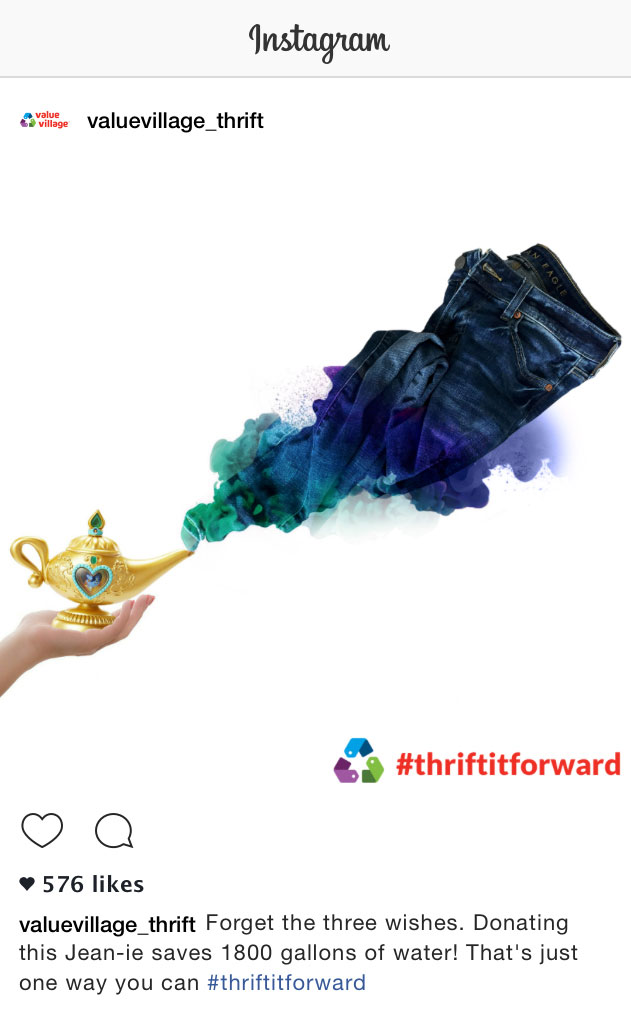
Additionally, I contributed my own mockups of earned, paid, owned, and shared content. One trendy piece of content we created was a “Jean-ie” ad which would have hypothetically have been in partnership with Disney who were releasing the Aladdin remake later in the year that this project was completed.
After all of our research and design had been completed, we presented our campaign pitch to our teacher along with the different measurement tools and KPIs we planned on using if we were to actually carry out the campaign. We planned to use traditional social media interactions such as social shares, tags, views, followers/subscribers, and likes/dislikes as well as more active engagement such as hashtag uses, coupon code usage from email blasts, membership signups and comments. Our instructor was ultimately very impressed with the campaign, however, the biggest win for me was that Value Village ended up using a marketing strategy similar to ours after we completed our campaign. My group and I were so excited that they also realized the need to capitalize on the wave environmentally conscious shopping!